More people wanting
to keep bees, and the problem with bee numbers falling, has led to the price of
bees rising; this has meant they have become of interest to thieves. This can
be especially worrying for those of us who put our hives out in the forest
where we are trying to take advantage of the flowering heather. Germany, Australia, Israel,
Japan and America have all recently reported that hive theft is on the increase.
So what can you do to help prevent this happening to you? Here are some tips:
- Make sure your hives
are not visible from the road, footpaths or other public access routes.
- Branding or carving
hive parts, or writing on them with indelible markers will help. Try to mark in
areas that are less obvious or difficult for thieves to sand down, like in
corners. Mark with your post code or surname, something you will be able to
quote to the police. UV pens are available too at a low cost and this
will add to the likelihood that your marking will survive if the police find
your hive.
- Check Google Maps on the
Internet to see if the satellite view of where you put your hives can be seen –
thieves use this internet tool to spot where apiaries are and then go to the
location to steal them.
- For a high tech
solution, there are products like Smartwater; each batch is unique and the police can take samples found on property
recovered and trace goods back to their owners through this product.
 Some apiarists are
fitting small GPS locators, like buddi, to their hives (again – not the cheapest solution); typically
professional apiarists are attaching these to a small number of their hives and
then if they are stolen as a batch, they have a chance of quickly finding out
where the hives and the thieves are.
Some apiarists are
fitting small GPS locators, like buddi, to their hives (again – not the cheapest solution); typically
professional apiarists are attaching these to a small number of their hives and
then if they are stolen as a batch, they have a chance of quickly finding out
where the hives and the thieves are. - Don’t use ‘Beware of the Bees’ signs; it’s a big give
away!
- If you screw your
brood box and hive base together, and screw those into a concrete stand/base,
thieves will be unable to take the brood box away.
- Another option is using ground anchors that have a loop of
steel on the top (often used for tethering dogs or bikes). If you then attach a
small padlock hook to the base of your brood box, you will be able to chain the
brood box to the steel loop in the ground, making it immovable.
- Many people strap
their hives to their stands where the stands have extra long legs buried into
the ground. OK, but remember the hive straps can easily be cut; so screwing the
hive into the buried stand would make it more secure.
- Reduce the number of
people who know you have bees at a specific location; they could unwittingly
pass on the information in conversation to thieves.
- Make sure gates
providing access to your apiary are locked and high. Make sure fences are high and
cannot be easily breached; it’s not easy to carry a hive over a high fence or
gate.
- Thieves usually work at night, so a
security light trained on your apiary would soon put them off, especially if the
light would alert nearby houses.
- Your spare supplies
are kept in the shed? Make sure the shed is locked, it’s well secured; I have a
small burglar alarm fitted in my shed (£5!)
and signs on the shed window warning thieves that it is protected.
- Contact alarms are very cheap now;
these consist of two small (no bigger than a small matchbox) electronic
(battery) devices that are connected to each other magnetically only. If they
are separated a loud and piercing alarm is released until they are connected
again. If one is fitted to your brood box/floor and the other to your stand
(which should be heavy or tethered to the ground) then this makes an effective
hive alarm!
- You can buy mock CCTV cameras that could be pointed
at the apiary; it could be enough to worry thieves that they could be real. Or
you could fit real CCTV triggered on a sensor that then records
on its own storage that you can load on a computer if there is a theft. Don’t buy bee hives on eBay unless you are sure they are not stolen; this
is how many stolen hives are sold. Ask questions about their history, why they
are being sold. Also, eBay Sellers with very low feedback responses are often
people that set up one account to sell something stolen, then close the account
as soon as the sale is made.
- If you are unlucky –
report the theft to the police and warn your local bee keeping association so
other members can be on the lookout.
I read recently that
in the USA a beehive ‘heist’ led to an apiarist thief being prosecuted on
several accounts of grand theft, petty theft and trespassing. Hopefully similar
harsh sentences will be handed out here in the UK.
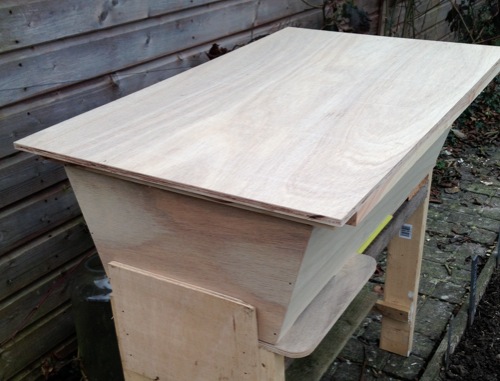 My new Top Bar hive arrived a little while ago and I had a lot of fun putting it together with the less-than-complete instructions, but there is not much to it and it is pretty obvious what you need to do. They are very cheap compared to the National hives I have used to date. £65 from Thornes and that includes a £10 donation to Bees for Development. I made a stand out of scrap wood (as I usually do for my hives) and it looks pretty good, even if it is made out of plywood. It will be interesting to see how it lasts through next winter. I will varnish it soon (on the outside only of course) and also give the roof a covering of felt or something similar. All I need now are some bees to put in it - but the days are getting warmer again now so there will be plenty of chances to catch a swarm soon.
 The hive roof just sits on top of the top-bars which can be seen more clearly in my second picture which shows the inside of the hive, the mesh floor, the sliding cover for the mesh floor and a stack of top-bars. You can see that the bar on the top has been turned over so the line of wax is visible - I melted some old wax into grooves cut into each top-bar as a guide for the bees to build on. They don't always follow it though - one friend of mine told me his bees built combs at 90 degree angles to the top-bars which was pretty tricky for him to deal with. I shall post later on in the season as things progress with this hive, so I can share what I learn and how the bees get on...
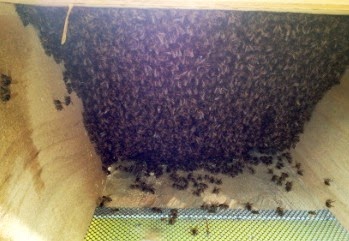 ...well, last week I picked up a swarm from a local village; it was a good size and so I decided to get it into the top bar hive to see if they would take to it. I got the swarm into the hive well and got the top bars back onto the hive. After a couple of hours they were all in there and seemed like they were happy enough. I checked on them today and they were taking in pollen, which is an indication that the Queen is laying brood. I opened up the far end of the hive to see if I could see them on the other end. As you can see from this photo, there are plenty of bees and although I could not see any comb, there seemed to be some in there; it was just covered in bees. They seem to be building the comb across the bars as I hoped they would. Now I have to give them the chance to build up the colony; it's going to be very interesting to see how they get on.